
Put Your Business Hat On: Entrepreneurship Can Save the Arts
By Mark Harrison, Founder, SponsorshipX
I spent two and a half days at the 2026 Canadian Arts Summit, organized by Business/Arts and the Banff Centre for Arts and Creativity. I was a panellist and by default, an avid attendee. I love immersing myself in conferences. One delegate asked me why I stuck around after my talk. I said to learn!
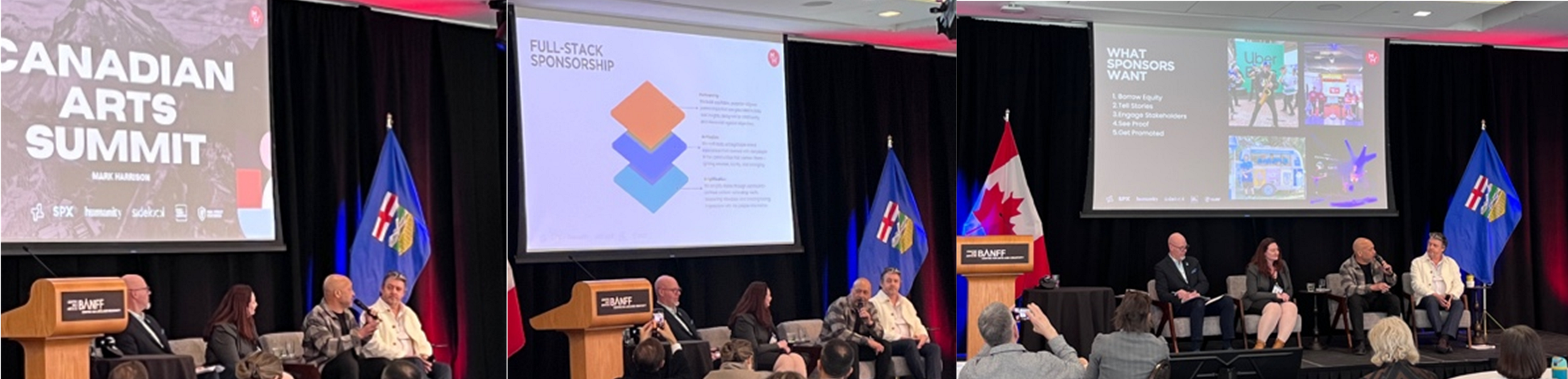
I came away with one conviction. The sector needs to stop waiting to be saved and start building businesses.
Operating costs for Canadian arts organizations have risen 41% since 2019. Corporate sponsors are withdrawing. Government funding to the Canada Council has been cut and continues to decline. More than 70% of Canadian artists juggle multiple jobs. The social case for arts funding has been made brilliantly for decades. It has not moved the needle fast enough. The answer is not a better argument. It is a better business model.
Courtney Senior is a Toronto-based abstract artist who also works in technology marketing. Around 2014, she had more paintings than her condo could hold. She wrapped them in kraft paper, wrote "Hello, I'm an original abstract painting in need of a loving home. FREE ART #ArtandFound," and left them on park benches. Her father died. She painted through the grief. His birthday was March 12th. In January 2021, she turned a personal practice into a coordinated global event. Her goal was 50 artists. The first International Art & Found Day drew 478 artists across 33 countries. By 2025: over 1,600 artists in 47 countries. No institutional backing. No grants. A hashtag, a website, and a human story.
Vinessa Redford picked up her first paintbrush in February 2021. Self-taught. Pandemic lockdown. Four years later: 324,000 Instagram followers. DeSerres brand ambassador. Teaching watercolour through the National Gallery of Canada's Online Studio. Juried into Artist Project 2026. A national retail storefront campaign launching this spring. She did not wait for permission. She built an audience, documented her story, and made herself a compelling investment. (Full disclosure: Vinessa is my sister.)
Neither of these artists runs a major institution. Neither has a development team. Both speak fluent sponsorship, not because they studied it, but because they built something real and made it visible.
Canada's live music sector contributed $10.92 billion to GDP in 2023 and created more than 101,000 jobs. Entrepreneurs, not grant writers, built those numbers. Mike Anderson launched the Great Outdoors Comedy Festival in Edmonton in 2021 as a COVID-safe outdoor show. By 2025, it had expanded to six cities across North America. Whitecap Entertainment in Charlottetown produces the Cavendish Beach Music Festival, draws 60,000 visitors annually, and launched the Sommo Festival, pairing live music with celebrity chefs on a second stage. Troy Vollhoffer grew up in Regina, worked as a stagehand at the Big Valley Jamboree, used a Pittsburgh Penguins signing bonus to build a production company, took over the struggling Craven festival in 2005, and scaled it into Country Thunder now seven festivals across North America, $22 to $23 million annually in talent spend, and a private equity investment in 2026. A Canadian from a small Saskatchewan town built a continental entertainment company. That is entrepreneurship.
The Confederation Centre of the Arts commissioned Tell Tale Harbour, an original Canadian musical co-written by Great Big Sea's Alan Doyle. The 2022 world premiere became the top-selling show in the Charlottetown Festival's history. After a Newfoundland tour and a full rework, the show is now heading to Toronto with co-producers David and Hannah Mirvish. A publicly supported arts institution created original IP, toured it regionally, and moved it into commercial production with Canada's largest theatre producer. That is the model.
One of the delegates at the Summit grew up in a small town. She mentioned it in reference to the day's conversation about why Canada equates hockey to its culture. We talked about the rink. Every small town in Canada has one. The community built it, maintains it, floods it in November, and fills the stands on Friday nights. Not because hockey is culture, though it is, but because of what the rink represents. The belief that someone from here could make it. The infrastructure justifies the investment because the pipeline is real. Azilda, Ontario, a small francophone community outside Sudbury, built a rink. That rink produced Randy Carlyle, Norris Trophy winner, Stanley Cup-winning coach, and one of the best defencemen of his generation.
Jesse Wente challenged delegates at the Summit to ask why a rink is considered more essentially Canadian than a gallery or a theatre. It is the right question. The rink is not just a building. A community declares that talent lives here, that it is worth developing, and that the return, even if only one kid in a generation makes it, justifies every hour of ice time and every dollar of maintenance. Arts organizations produce careers, exports, IP, tourism, and creative entrepreneurs at scale. But that argument has never been made as loudly or as consistently as the hockey argument.
Every town that built a rink was making a bet on its own people. The arts sector needs to make the same bet.
And back it with business plans.